The debate around Artificial Intelligence vs Human Intelligence has become one of the most discussed topics in the digital era. As AI technologies continue to transform industries, many people wonder whether machines can eventually surpass human intelligence. While artificial intelligence can process large amounts of data at incredible speed, humans possess creativity, emotions, and critical thinking abilities that remain difficult to replicate.
Understanding Artificial Intelligence vs Human Intelligence is important because both are shaping the future of work, education, healthcare, and business. Rather than viewing them as competitors, many experts believe they will complement each other and create new opportunities.

What Is Artificial Intelligence?
Artificial Intelligence (AI) refers to computer systems designed to perform tasks that normally require human intelligence. These tasks include learning, problem-solving, language understanding, image recognition, and decision-making.
AI systems rely on algorithms, machine learning, and vast datasets to improve performance over time. Modern AI is used in virtual assistants, chatbots, self-driving cars, recommendation systems, and medical diagnostics.
In discussions about Artificial Intelligence vs Human Intelligence, AI is often praised for its speed, accuracy, and ability to process massive amounts of information.
What Is Human Intelligence?
Human intelligence is the natural cognitive ability of humans to learn, reason, understand emotions, solve problems, and adapt to new situations. It involves creativity, self-awareness, ethical judgment, emotional intelligence, and social interaction.
Unlike machines, humans can think beyond data patterns and make decisions based on experience, values, and emotions. This makes human intelligence unique and difficult to fully replicate.
The comparison of Artificial Intelligence vs Human Intelligence highlights the strengths that humans continue to hold in many areas.
Artificial Intelligence vs Human Intelligence: Major Differences
1. Learning Ability
AI learns from data and algorithms. The more data it receives, the better it can perform specific tasks.
Humans learn from experiences, observation, education, emotions, and social interactions. Human learning is more flexible and adaptable.In the debate of Artificial Intelligence vs Human Intelligence, humans have a broader learning capability.
2. Speed and Efficiency
AI can process millions of calculations within seconds. It can analyze vast datasets far faster than humans.
Humans are slower when handling large-scale data analysis.This is one area where Artificial Intelligence vs Human Intelligence clearly favors AI.
3. Creativity
AI can generate content, images, and designs based on existing patterns.
Humans create original ideas through imagination, emotions, and inspiration.
When discussing Artificial Intelligence vs Human Intelligence, creativity remains a major human advantage.
4. Emotional Intelligence
AI can recognize emotions through data analysis but does not truly experience feelings.Humans understand emotions, empathy, relationships, and social dynamics.
This is another key difference in Artificial Intelligence vs Human Intelligence.
5. Decision-Making
AI makes decisions based on programmed rules and available data.
Humans consider ethics, intuition, values, and emotions when making decisions.
6. Adaptability
AI performs best in environments it has been trained for.
Humans can adapt quickly to unexpected situations and unfamiliar challenges.
Therefore, in Artificial Intelligence vs Human Intelligence, adaptability strongly favors humans.
Artificial Intelligence vs Human Intelligence: Advantages Comparison
| No. | Artificial Intelligence (AI) Advantages | Human Intelligence Advantages |
| 1 | Processes data extremely fast | Thinks creatively and innovatively |
| 2 | Works 24/7 without fatigue | Understands emotions and empathy |
| 3 | Reduces human errors in calculations | Makes ethical and moral decisions |
| 4 | Handles massive datasets efficiently | Adapts quickly to new situations |
| 5 | Automates repetitive tasks | Uses intuition and common sense |
| 6 | Delivers consistent performance | Learns from real-life experiences |
| 7 | Performs complex computations instantly | Builds relationships and teamwork |
| 8 | Improves productivity and efficiency | Solves unique and unpredictable problems |
| 9 | Stores and retrieves huge amounts of information | Demonstrates leadership and motivation |
| 10 | Scales operations with minimal additional cost | Creates original ideas, inventions, and art |
Key Takeaway
AI excels in speed, accuracy, automation, and data processing, while Human Intelligence excels in creativity, emotions, adaptability, ethics, and innovation. The future will depend on combining the strengths of both rather than choosing one over the other.
Limitations of Artificial Intelligence
Although AI offers many benefits, it also has limitations.
- Lacks genuine emotions
- Cannot fully understand human values
- Depends on data quality
- Can be affected by algorithmic bias
- Requires significant technical infrastructure
These challenges show that Artificial Intelligence vs Human Intelligence is not simply about replacing humans.
Limitations of Human Intelligence
Humans also face limitations.
- Prone to errors
- Limited memory capacity
- Can become tired or distracted
- Slower data processing speed
- Influenced by emotions and biases
Understanding both strengths and weaknesses helps create a balanced view of Artificial Intelligence vs Human Intelligence.
Will AI Replace Human Intelligence?
One of the biggest concerns surrounding Artificial Intelligence vs Human Intelligence is whether AI will replace humans.
The reality is that AI is more likely to automate specific tasks rather than replace human intelligence entirely. Jobs involving repetitive and predictable work may be automated, but careers requiring creativity, leadership, emotional intelligence, and strategic thinking will continue to rely heavily on humans.
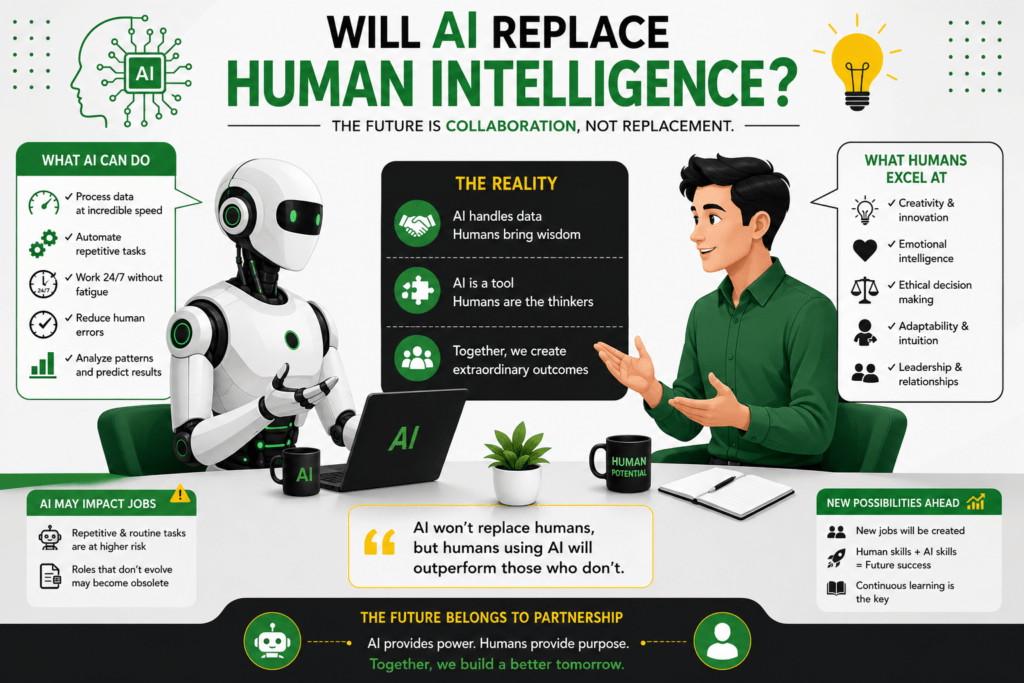
Most experts believe AI will act as a powerful tool that enhances human capabilities rather than replacing them.
Future Jobs Created by AI
As AI continues to grow, new career opportunities are emerging.
1.AI Engineer
Designs and develops artificial intelligence systems.
2.Machine Learning Specialist
Creates algorithms that enable machines to learn from data.
3.Data Scientist
Analyzes large datasets to generate valuable insights.
4.AI Ethics Consultant
Ensures AI systems operate responsibly and fairly.
5.Robotics Engineer
Builds and maintains intelligent robotic systems.
6.AI Product Manager
Oversees the development and implementation of AI-based products.
7.Cybersecurity Analyst
Protects organizations from digital threats and cyberattacks.
These careers demonstrate how Artificial Intelligence vs Human Intelligence can create new professional opportunities.
Industries Most Affected by AI
- Healthcare
AI assists doctors with diagnostics and patient monitoring.
- Education
AI-powered learning platforms personalize education experiences.
- Finance
Banks use AI for fraud detection and risk assessment.
- Manufacturing
Automation increases efficiency and productivity.
- Marketing
AI helps businesses understand customer behavior and optimize campaigns.
The impact of Artificial Intelligence vs Human Intelligence is already visible across these sectors.
The Future: Collaboration Instead of Competition
The future is unlikely to be a battle of Artificial Intelligence vs Human Intelligence. Instead, it will be a partnership where both work together.
AI will handle repetitive tasks, process data, and provide insights. Humans will contribute creativity, empathy, leadership, and ethical decision-making.
Organizations that successfully combine human talent with AI technologies will have a significant competitive advantage.
This collaborative approach can drive innovation, productivity, and economic growth worldwide.
Conclusion
The discussion of Artificial Intelligence vs Human Intelligence is not about determining a single winner. Artificial intelligence excels in speed, automation, and data analysis, while human intelligence shines in creativity, emotional understanding, ethics, and adaptability.
As technology continues to evolve, the most successful individuals and organizations will be those that learn how to combine the strengths of both. AI can enhance human capabilities, but the unique qualities of human intelligence remain irreplaceable.
The future belongs not to AI alone or humans alone, but to the powerful partnership between artificial intelligence and human intelligence.
